
Australia's exploration disconnect: why higher oil prices no longer drive investment

This article was the featured story in the September 2026 edition of the PESA Gazette.
Introduction
For decades, Australia's petroleum exploration cycle appeared relatively predictable: when oil prices rose, exploration investment generally followed; when prices fell, exploration contracted. This relationship shaped investment decisions, corporate strategies and the opening of successive petroleum provinces.
However, when inflation-adjusted exploration expenditure is considered alongside real oil prices and exploration intensity, the post-2015 period looks fundamentally different from the preceding four decades. Exploration has remained subdued despite periods of significantly higher oil and gas prices, suggesting that Australia's exploration decline may no longer be simply cyclical, but increasingly structural.
The historical relationship (1970s–2014)
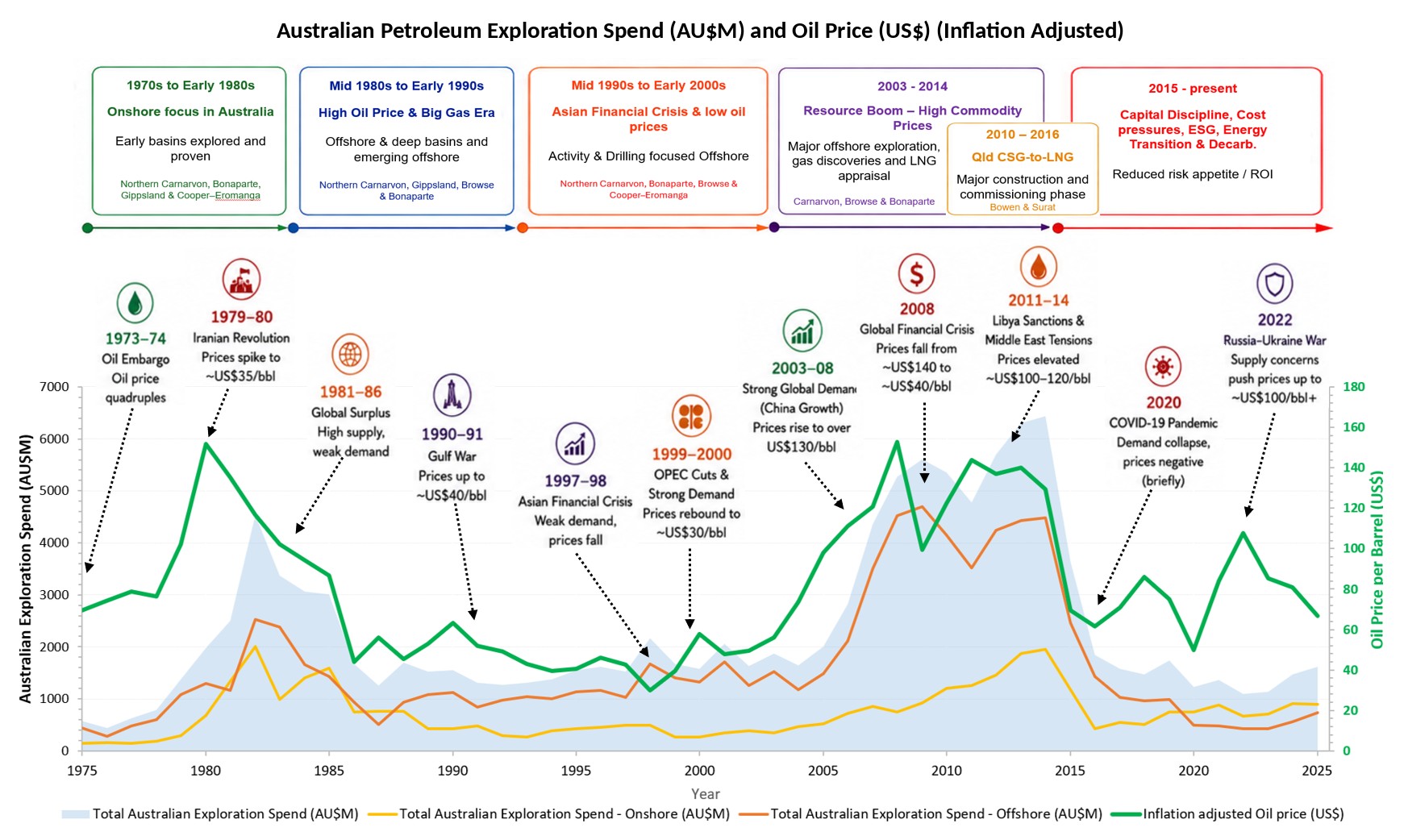
The exploration-spend graph shows a relatively strong relationship between commodity conditions and exploration through much of the 1970s to mid-2010s (Australian Bureau of Statistics, 2026; Macrotrends, n.d.; RateInflation, 2026). The early 1980s boom saw rapidly rising oil prices coincide with increased exploration across the North West Shelf, Bass Strait, Gippsland and other emerging provinces (Geoscience Australia, 2023a).
The 2003–2014 period was arguably Australia's most significant modern exploration and investment cycle. High commodity prices, Asian energy demand and LNG development supported substantial offshore exploration and appraisal, particularly across the Northern Carnarvon, Browse and Bonaparte basins (Geoscience Australia, 2019; Geoscience Australia, 2023b).
The Queensland CSG industry created a parallel onshore exploration and development cycle, culminating in the large-scale LNG developments at Gladstone (Geoscience Australia, 2014). Together, these developments created a powerful link between exploration, resource definition and downstream LNG demand (Geoscience Australia, 2023b). The subsequent LNG investment wave transformed many discoveries into major projects, including Gorgon, Wheatstone, Ichthys and Prelude, alongside Queensland's CSG-to-LNG developments. The 2014–16 oil-price collapse then produced the expected sharp contraction in exploration.
Post-2015 divergence
Oil prices subsequently recovered, including the major increase during 2021–22, yet Australian exploration expenditure did not return to previous levels. The ABS data shows that petroleum exploration expenditure fell sharply after the 2015 peak and has remained well below levels associated with the previous exploration cycle. Geoscience Australia similarly identifies exploration and investment in Australian gas as having remained relatively subdued in recent years (Geoscience Australia, 2025).
Australia continues to have prospective opportunities across both onshore and offshore basins, with ongoing appraisal, development-related exploration, selected unconventional activity and opportunities associated with new and existing acreage (Australian Government, 2025; Geoscience Australia, 2025). However, the scale and breadth of exploration remain substantially below the levels associated with the 2003–2014 period. The change suggests a reduced and more selective exploration system, increasingly concentrated on basins, plays and projects where geological potential aligns with clearer commercial pathways.
Three exploration eras
The combined datasets suggest three broad phases:
- 1975–1998: resilient and opportunity-driven. Companies continued investing through commodity cycles as new basins were opened and Australia's resource base expanded.
- 2003–2014: expansionary and LNG-driven. High commodity prices, Asian demand and LNG development supported substantial offshore exploration, appraisal and resource maturation.
- 2015–present: structurally constrained. Commodity prices remain important, but no longer appear sufficient to generate a comparable exploration response. Basin maturity, capital discipline, infrastructure, regulation, capital competition and energy-transition uncertainty increasingly influence investment decisions.
Why might this be structural?
Several factors appear to be interacting. Basin maturity is increasingly important: Australia's major petroleum provinces have been explored for decades, leaving opportunities that may be smaller, deeper, technically harder or further from infrastructure. Capital competition has intensified, with Australian exploration competing globally for investment against shorter-cycle opportunities such as US unconventional plays.
The LNG megaproject cycle also changed the investment landscape. The major developments of the 2000s and early 2010s created substantial gas-processing and export capacity. In some regions, this provides infrastructure for future discoveries; in others, it may reduce the immediate need for another generation of large-scale projects.
Regulatory and approval uncertainty is also influencing investment decisions. The Australian Government's Future Gas Strategy identifies project approval processes, legal challenges, changing government interventions, financing constraints, declining social licence and uncertainty around future gas demand among factors potentially contributing to low investment (DISR, 2024). Energy-transition uncertainty further increases the risk attached to long-cycle exploration.
Exploration intensity reinforces the shift
The exploration-intensity indicator (data from the Australian Bureau of Statistics; RateInflation, 2026) highlights the change. Historically, Australia committed substantial exploration capital relative to prevailing oil prices, with particularly high levels during the late 1990s and the LNG-driven cycle of the 2000s and early 2010s.
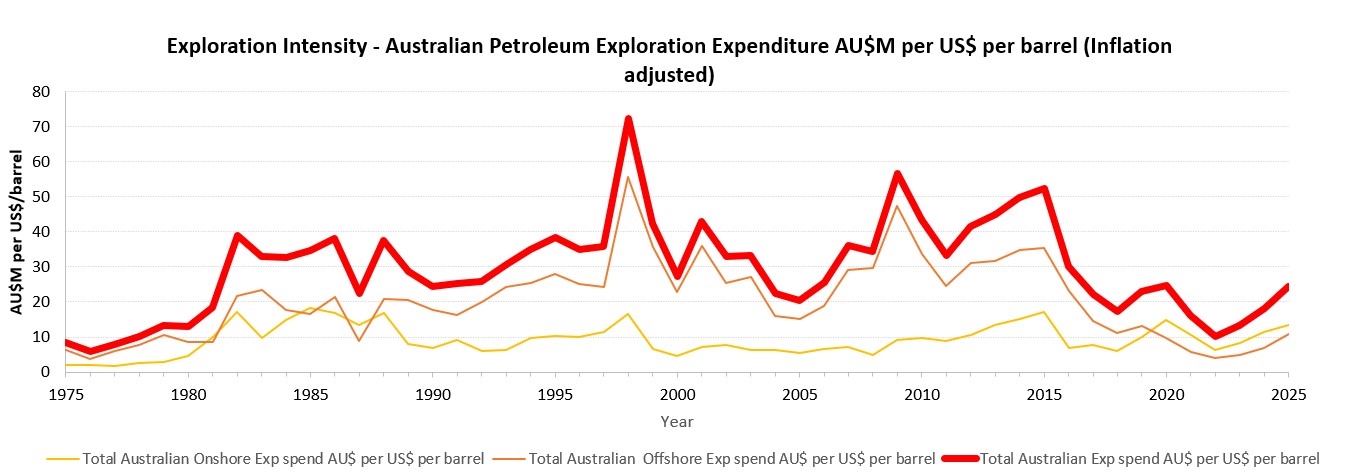
After 2015, intensity falls substantially and remains below earlier peaks. Even when oil prices return towards US$70–100/bbl, exploration expenditure does not respond proportionately. This suggests oil price may have become a less powerful trigger for Australian exploration investment.
Geography has changed over time
The timeline reinforces this shift. The 1970s and early 1980s were characterised by expansion of established petroleum provinces (Geoscience Australia, 2023a). During the 1980s and 1990s, exploration became increasingly offshore-focused, with the Northern Carnarvon, Browse and Bonaparte basins emerging as important frontier areas (Geoscience Australia, 2023a; 2023b). From 2003–2014, high commodity prices and LNG development supported the largest offshore exploration cycle and, in parallel, the Queensland CSG-to-LNG wave created a major new exploration focus in the Bowen and Surat basins.
Since 2015, activity appears increasingly concentrated on onshore appraisal, development, brownfield opportunities and selected unconventional resources (Australian Bureau of Statistics, 2024; Geoscience Australia, 2025). Exploration is becoming concentrated in fewer basins and projects with clearer commercial pathways.
A structural repricing of risk?
The data suggests that Australia's petroleum exploration system has undergone a structural repricing of risk, with exploration expenditure remaining well below its pre-2015 peak and activity shifting toward onshore opportunities and projects with clearer development pathways (ABS, 2024; Geoscience Australia, 2025). Oil price still matters, but may no longer be sufficient to overcome geological maturity, development costs, infrastructure constraints, regulatory uncertainty, capital competition and energy-transition risk.
Australia appears to be moving from an exploration model based on discovering and developing new petroleum provinces toward one focused on optimising existing resources, extending mature fields, developing selected unconventional resources and maximising existing infrastructure.
Implications for Australia's upstream future
Fewer frontier discoveries may reduce the pool of future projects capable of replacing mature production, increasing dependence on existing resources to sustain domestic supply and LNG exports. The central question is therefore no longer simply whether high oil and gas prices can stimulate Australian exploration, but whether high commodity prices are still enough to make Australian exploration competitive for global capital.
If they are not, the post-2015 decline may represent more than another down-cycle. It may mark the beginning of a new Australian upstream model: less frontier exploration, more appraisal and optimisation, greater capital selectivity, and a much higher hurdle for discovering the next generation of resources.
References
- Australian Bureau of Statistics (2024) Mineral and Petroleum Exploration, Australia. Canberra: Australian Bureau of Statistics.
- Australian Bureau of Statistics (2026) Mineral and Petroleum Exploration, Australia, March 2026. Canberra: Australian Bureau of Statistics.
- Australian Government (2025) 2025 Offshore Petroleum Exploration Acreage Release. Canberra: Department of Industry, Science and Resources.
- Department of Industry, Science and Resources (DISR) (2024) Resources and Energy Quarterly: June 2024. Canberra: Australian Government.
- Geoscience Australia (2014) Coal Seam Gas. Canberra: Australian Government.
- Geoscience Australia (2019) Browse Basin Petroleum Systems Study. Canberra: Australian Government.
- Geoscience Australia (2023a) Browse Basin. Canberra: Australian Government.
- Geoscience Australia (2023b) Gas: Australia's Energy Commodity Resources 2023. Canberra: Australian Government.
- Geoscience Australia (2025) Australian Energy Commodity Resources 2025: Gas. Canberra: Australian Government.
- Macrotrends (n.d.) Crude oil prices: 70 year historical chart. Macrotrends.
- RateInflation (2026) Australia historical consumer price index (CPI), 1948 to 2026. RateInflation.

