
Onshore PNG: what's holding exploration back, and what can move it forward

Onshore Papua New Guinea remains one of the most prospective yet least understood petroleum regions in the Asia Pacific. The upside is real, but the path from exploration to development is long and often underestimated.
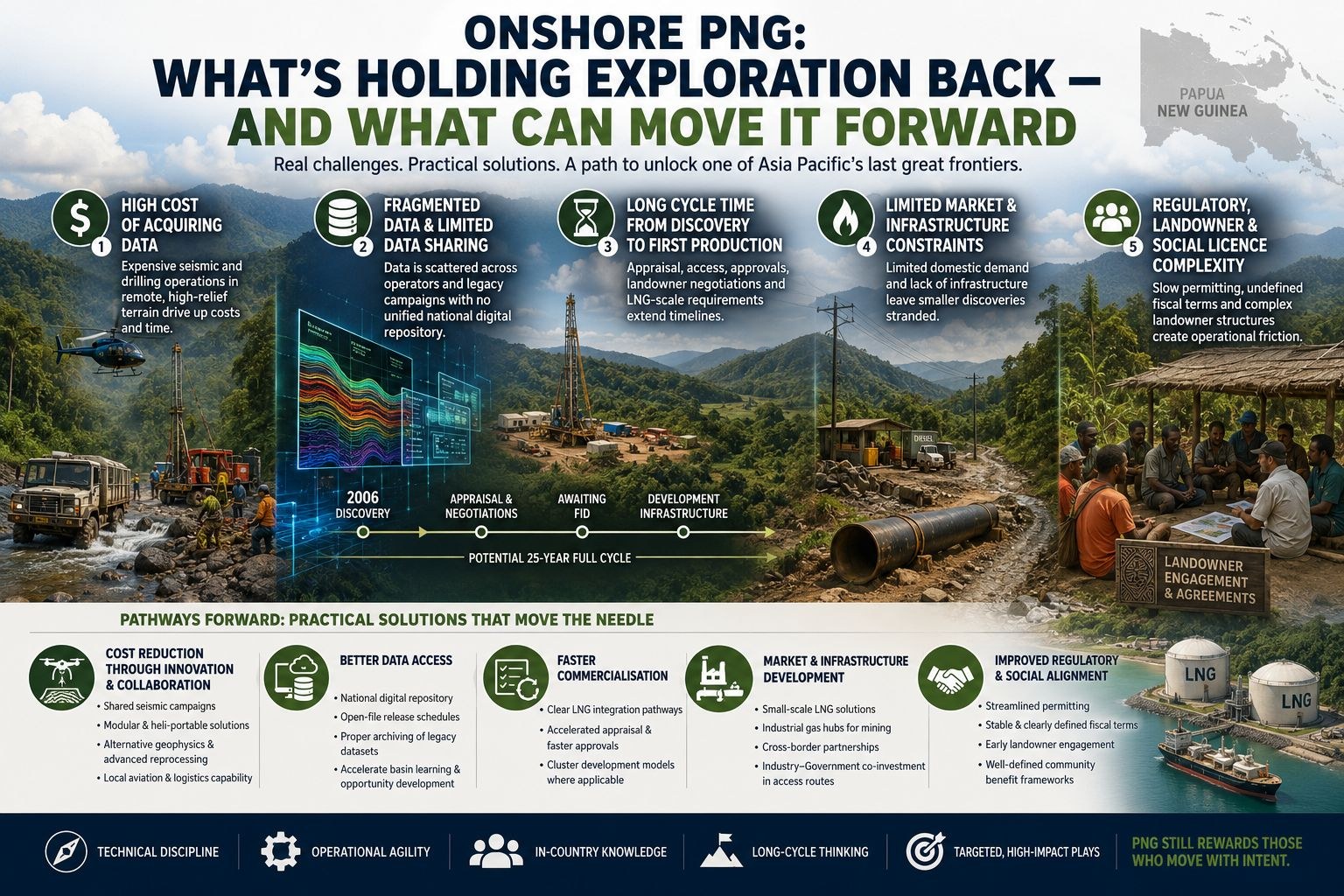
Five hurdles consistently slowing progress
1. High data acquisition cost. Seismic and drilling are among the most expensive in the world, driven by jungle line-cutting, helicopter support, river crossings, remote logistics, and major earthworks for pads and access roads.
2. Fragmented subsurface data. Data sits across operators and legacy joint ventures. Despite submission requirements, PNG lacks a unified digital repository, which slows basin learning and raises uncertainty.
3. Long cycle times. Appraisal, access, undefined approvals, landowner negotiations and LNG-scale volumes all extend timelines. Elk–Antelope shows how discovery to final investment decision can approach 25 years.
4. Limited market and infrastructure. Domestic gas demand is small. Many basins lack roads, pads, pipelines, airstrips and electricity infrastructure, leaving modest discoveries stranded.
5. Regulatory and landowner complexity. Slow permitting, undefined fiscal terms and clan-based negotiations create friction. Decisions can take more than 12 months.
What can move PNG forward?
- shared seismic acquisition
- modular facilities
- alternative geophysical methods
- better data access
- faster approvals
- LNG integration pathways and small-scale LNG
- industrial gas hubs
- cross-border partnerships
- co-investment in access routes
- clearer fiscal and community frameworks
Why mid-tier explorers can thrive
PNG rewards technical discipline, agility, modular thinking, and people with deep in-country knowledge. With smarter data strategies and collaborative infrastructure, mid-tier companies can secure a first-mover advantage in one of the last under-explored basins.
Over to you
If PNG could change one thing (policy, infrastructure, data access or market development), which would have the greatest impact?

