
PNG: where material exploration upside still exists

Drawing on my early career as a field geologist working across PNG's foreland and Highlands jungles, and more recently managing a PNG exploration portfolio, here is a concise summary and my current view of PNG's exploration landscape.
Exploration in PNG: a brief history
Papua New Guinea's exploration story began with early 20th-century oil shows in the Papuan Basin, but the late 1980s and 1990s marked the true height of activity. Oil discoveries at Kutubu, Gobe and Moran proved the commercial potential of PNG's complex fold-and-thrust geology and established the Highlands as a world-class petroleum province.
The 2000s brought a decisive shift toward gas-led exploration, with Hides, Angore and Juha underpinning PNG LNG and reshaping the country's energy landscape.
Over the past decade, onshore exploration has narrowed to targeted appraisal around the PNG LNG fields: optimising deliverability, refining structural models and maturing near-field opportunities. True frontier drilling has been rare. The last major wildcats were in the Gulf Province: Elk–Antelope (2006), testing a carbonate build-up, and Kimu-1 (2007), proving a new play concept. These wells effectively marked the end of PNG's onshore frontier push.
Where PNG exploration stands today
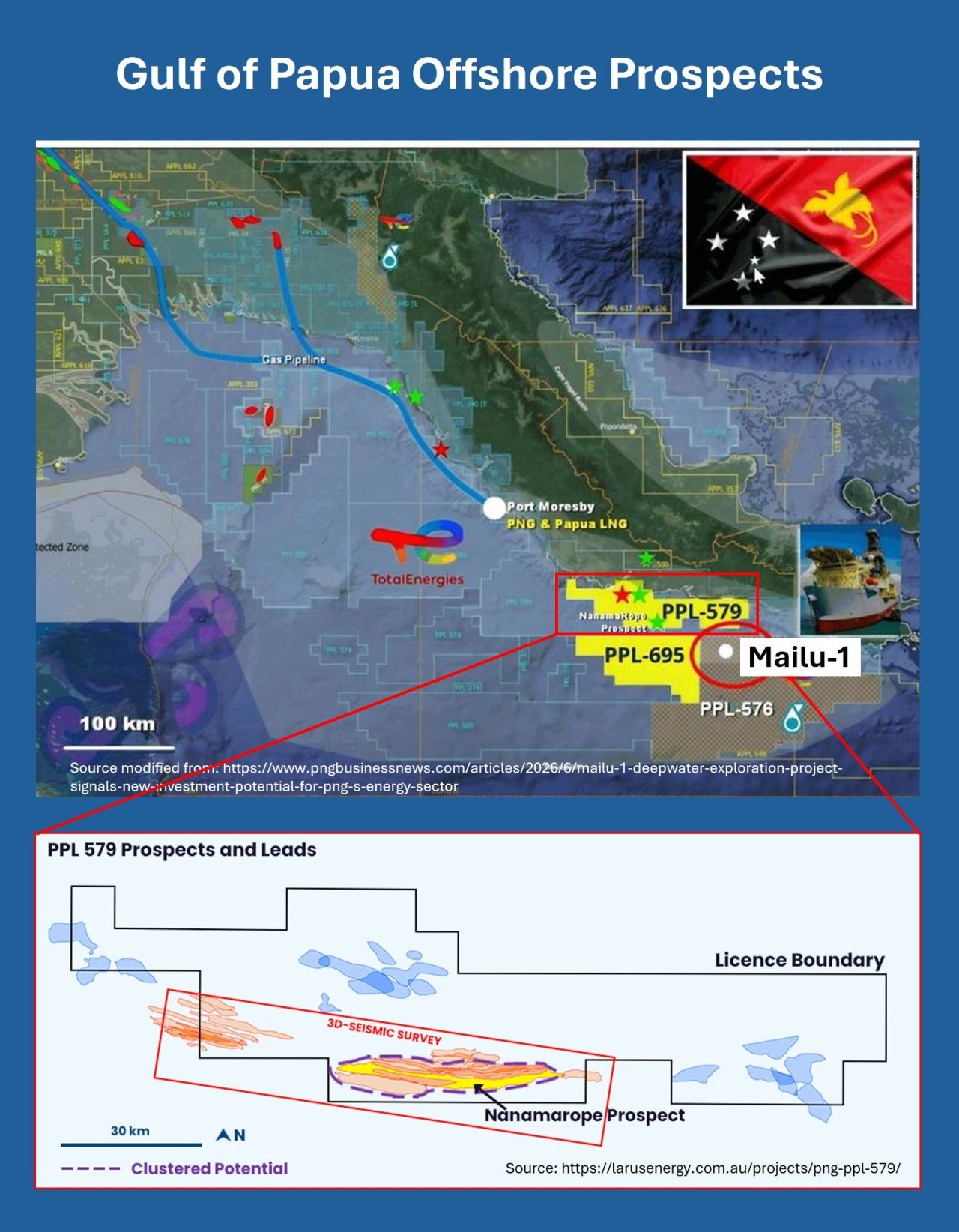
While onshore PNG remains largely under-explored, the country is now entering a new phase in which frontier appetite has shifted offshore. Modern seismic has opened vast deepwater basins. At the time of writing, the first deepwater well is being drilled in the Gulf of Papua (Mailu-1), and large offshore basins remain materially under-explored: a rare combination in today's global exploration landscape.
Capability matters more than size
PNG's geological systems continue to reward explorers with discipline, technical depth and long-cycle thinking, favouring those able to align exploration with both oil and LNG pathways. What's emerging is a setting where capability matters more than size, where ambitious mid-tier companies (Larus Energy's Nanamarope prospect is one example) can compete alongside majors, and where first-mover advantage remains very real.
In an industry increasingly defined by incrementalism, PNG offers something different: a genuine opportunity to think boldly again.
Over to you
Is the industry underestimating the remaining onshore potential in PNG, or has the frontier truly shifted offshore?

